‘Meticulously researched … a careful, readable and balanced examination of confusing evidence in one of history’s more painful chapters.’ The Newtown Review of Books
‘A powerful and deeply human exploration of life in the aftermath of one of history’s darkest chapters.’ Good Reading
‘A brilliantly orchestrated case study’ The Age
‘A powerfully moving book, Strange New World recounts the history of Belsen’s first post-liberation year in great detail, yet remains highly readable. Simultaneously scholarly and personal, Nadia Wheatley’s work reminds us why the Holocaust in general, and Belsen in particular, continues to demand our attention.’
Dan Stone, Professor of Modern History and
Director of the Holocaust Research Institute,
Royal Holloway, University of London
‘An astonishing book … What happened in those first days, weeks and months when the British threw open the gates of Bergen-Belsen and stumbled upon the horrific reality of the Nazi’s Final Solution? This book tells a startling new history of the aftermath of the Bergen-Belsen liberation and the encounters between the mostly Jewish survivors and the well-meaning but often ill equipped British medical personnel who arrived to aid in their recovery. Who better to tell this story than Nadia Wheatley, an accomplished writer, an astute historian and, remarkably, the daughter of one of the British medics who was there. At its heart is also a story of a daughter wrestling with the legacy of a difficult father.’
Professor Ruth Balint, UNSW
‘Wheatley’s book is both deeply researched and acutely sensitive to the human dimension of her subject.’
Inside Story
‘A harrowing, forensic and compassionate investigation of the afterlife of Bergen-Belsen as the Belsen Camp for Displaced Persons – the good done, the mistakes made, the moral conundrums and persistent prejudices that left Jews who had barely survived the concentration camps feeling “saved but not liberated”. Her interest sparked by an unlikely, unexpected family connection, the author’s examination of this extraordinary moment in history helps illuminate the heated politics around Israel and Palestine today.’
Linda Jaivin, author and translator
‘One tragedy of war is that its destructive effects continue long after the fighting stops. Nadia Wheatley’s powerful study of Belsen’s liberation and post-war existence offers evidence of this sad truth, but also of the human capacity to endure and to find hope in the darkest circumstances.’
Seumas Spark, adjunct fellow in
history at Monash University
‘A balanced and impeccably well-researched account of the often overlooked events that unfolded in the period after Belsen’s liberation. It is rich in detail and suffused with humanity, laying bare this passage of history in a way that is by turns intensely shocking, devastatingly moving and unexpectedly inspiring. Wheatley navigates the complexity with an impressive fluency, creating a comprehensive and profoundly thought provoking work that is compellingly readable.’
Dr James Bulgin, Head of Public History,
Imperial War Museum
‘In this meticulously researched yet highly readable account of the liberation of Belsen concentration camp, Nadia Wheatley draws on extensive historiography and new archival sources to provide a compelling narrative of the liberation of the camp and the survivors’ first year of freedom.’
Dr Christopher Knowles, Visiting Research Fellow,
King’s College London, and Joint Convenor,
Occupation Studies Research Network
‘A huge step forward in the historiography of Bergen-Belsen.’
Dr Thomas Rahe, former Director of the Department of
Research and Documentation at the Bergen-Belsen Memorial
‘[Tells the story of] Bergen-Belsen concentration camp survivors’ first year of freedom: displacement, rebuilding, stubborn hope. Wheatley honours resilience without romanticising hardship.’
The Australian
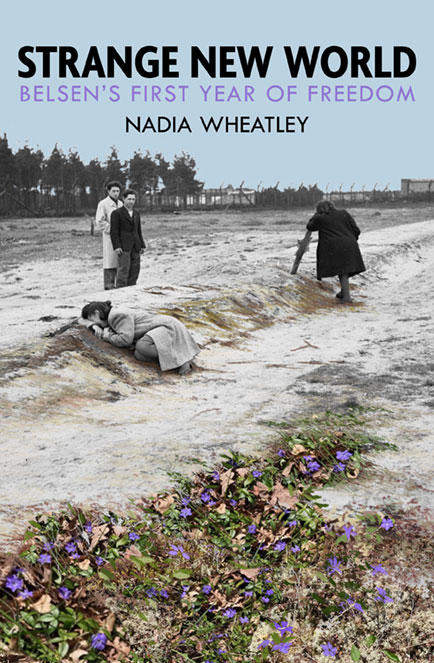
Award-winning author Nadia Wheatley reveals the untold horrors the Bergen-Belsen concentration camp survivors met when promised freedom by the allies – and the stunning resilience that carried them through.
The Liberation of Bergen-Belsen concentration camp on 15 April 1945 was hailed as a triumph of British victory over Nazi Germany. But for the 55,000 survivors of the ‘Horror Camp’, freedom brought new tragedy: a quarter died in the following five weeks. For many of those who lived, liberation meant barbed wire, military rule and a different kind of confinement.
Evacuated to a nearby army barracks – soon Europe’s largest Jewish Displaced Persons’ camp – survivors faced endemic disease, bureaucratic indifference and an uncertain future. Josef Rosensaft, Jewish political leader in the camp, called the first year of freedom ‘more oppressive to our souls than the years in the hell of Auschwitz and Belsen’: ‘we saw before us a new kind of world, cold and strange’.
Strange New World is the untold story of Belsen’s survivors. Refusing to remain victims, they fought to reclaim agency, build community and forge new lives from the ruins. Their history resonates today as millions of displaced people worldwide navigate the gap between rescue and true freedom.